

To become a world-class organization fostering research, innovation, quality, collaboration, and inclusion.
To train and educate human resource to play a key role in the economy of pakistan and to become responsible global citizens.
purpose, impact, compassion, quality, collaboration, innovation inclusivity
Pakistan Institute of Fashion and Design is a Specialist Design Institute, catering to the future demands of the industry. It’s goal is to provide a comprehensive design education focusing on product demand, design aesthetics, value and consumer requirements.
It was in 1994 that affiliation was established with the Ecole de La Chambre Syndicale de La Couture Parisienne originally developed by the French Federation of Fashion Designers in 1927. Intensive consultations were held to draw out a comprehensive four-year curriculum that would not only prepare the students for the local demands but also empower them to meet global standards. Mrs. Abbasi Akhtar, the first Principal, along with qualified faculty specially recruited from within and outside Pakistan, were involved in developing the curriculum which was thoroughly vetted for conformity with French standards of fashion design. In 2005, PSFD was affiliated with Mod’Spe Institute of Marketing, Paris established by Federation Francaise du pret-a-porter Feminin Paris in 1993, with the objective of developing curriculum and training faculty for the Fashion Marketing and Merchandising Programme.
In 2007 collaboration was established with the University College of Boras, Sweden. In 2008, it got affiliated with the Asian Institute of Gemological Sciences (AIGS), to provide requisite exposure to students and faculty of Jewellery Design and Gemological Sciences. The most significant landmark in the history of the institute is the degree-awarding status through the PIFD Act of 2011. The graduates completing their degree programmes will now be recognized at the national and international level.
Pakistan School of Fashion Design (PSFD), the premier Fashion Design Institute in Pakistan, started its humble beginning in a rented campus in 1994, as a Project of Export Promotion Bureau (EPB), Ministry of Commerce, Government of Pakistan. The Vice-Chairman EPB, late Mr. Abu Shamim M. Ariff envisioned the establishment of the first Fashion School in the country. Mr. Ismail Qureshi, the Commercial Counselor in Paris, brought Mr. Oliver Lapidus, and Lahore was chosen to be the birthplace of PSFD.
Mr. Lapidus was also instrumental in the ground breaking decision by the Federation of Haute Couture, for PSFD affiliation with the leading French School, L’Ecole de la Chambre Syndicale de la Couture Paris. This initiative was implemented on the ground by Mrs. Abbasi S. Akhtar, the first Principal of PSFD with the support of Madam Olga Saurat, Director, La Chambre, and Ms. Shazia Wiqar, a former student of La Chambre Syndicale. The faculty included Mr. Yasir Waheed, Ms. Maryse Faux, Ms. Angelika Kukla, Ms. Anila Qayum, Ms. Shama Saeed, and Mr. Philippe Germain-Vigliano. For sustainability, PSFD was very fortunate to have the support of the then Minister for Commerce, Mr. Ahmad Mukhtar, and Secretary Commerce Mr. Salman Farooqui. After 3 years, in 1996, Mrs. Naveed Shahzad took over as Principal, and the first Executive Committee (EC) was established with Mr. Ismail Khurram as its Chairman. The Institute was then supported by the Chairman, EPB, Mr. Khawaja Bilal, who was responsible for the renewal of affiliation with L’Ecole de la Chambre Syndicale de la Couture, Paris in 1998.
In 2001, Prof. Hina Tayyaba became the Principal and was given the task to renew the School’s affiliation with the French School. The new Director La Chambre, Mr. Francois Broca provided all-out support in affiliation and improving the curriculum. The plan of establishing a purpose-built campus was pushed into action with the support of then Vice-Chairman EPB, Mr. Ijaz Ahmad Qureshi and Secretary Commerce Mr. Kamal Afsar. The financial system was introduced and implemented under the guidance of Chairman Executive Committee, Mr. Farrukh Hussain Sheikh, Mr. Pervaiz Hanif and Director General, EPB, Mr. Tariq Iqbal Puri. As chairperson of the Finance Committee, Mr. Pervaiz Hanif contributed a lot to the financial set up of the Institute and getting the unqualified bi-annual audit reports by Chartered Accountants, Ministry of Commerce Auditors and Auditor General of Pakistan.
In 2003, then Minister for Commerce, Mr. Hamayun Akhtar Khan, asked the Principal to devise a strategy for building a new campus for PSFD. The same year, Mr. Avais M. Hussain joined as Chairman of Executive Committee and worked closely with then-Secretary Commerce, Mr. Tasneem Noorani and the Principal on their primary agenda to upgrade PSFD’s legal status and Financial Autonomy. Active and concrete support for possession of the land was provided by Mr. Avais M. Hussain, Mr. Ismail Qureshi, Mr. Naved Akram Cheema, Mr. Kamran Lashari and Mr. Ikhlaq Tarar. Mr. Jehangir Tareen, went all out to get the land for the school in 2004, and it was acquired by the Institute in 2005. The same year, with the support of Deputy Chairman, Planning Commission, Mr. Akram Sheikh, the PC-1 for construction of the new campus was approved. Mr. Rana Shahzad took over as Project Director. An Implementation Committee was constituted with Director General, TDAP, Lahore, as Chairman to oversee the progress of the project. As Director General, TDAP, Lahore, Mr. Haroon Rashid, Mr. Naved Arif, Mr. Agha Zafar Mehdi Shah and Mr. Muhammad Irfan Tarar have contributed to the project.
In 2005, the programme of Fashion Marketing and Merchandising was introduced in affiliation with Mod’spe Institute of Fashion Marketing, Paris. Mr. Jean-Pierre Mocho, President, Federation Francaise Du Pret a Porter Feminin, Mr. Rene Mardellet, Managing Director, Mod’spe and Mr. Jehanzeb Khan, then Commercial Counselor in France, were instrumental in the process.
In 2006, affiliation with La Chambre, Paris was renewed, and another PC-1 was made by Prof. Hina Tayyaba to introduce the concept of establishing 4 Schools having synergies with each other. Chairman EC, Mr. Avais M. Hussain, Minister for Commerce, Mr. Hamayun Akhtar Khan, Secretary Commerce, Mr. Tasneem Noorani, and Mr. Syed Asif Ali Shah fully supported the concept through to its materialization. Apart from the Ministry of Commerce, all-out support was also extended by the Minister for Industries and Production, Mr. Jehangir Tareen, and CEO SMEDA, Mr. Shahab Khawaja. They invited the Institute to become part of strategic working groups, organized by the Ministry of Industries and Production and supported by US Aid to work on different labour intensive sectors such as Gems and Jewellery, Furniture, Textiles, and Leather. The meetings of Trade Policy and Sector Development Groups contributed to giving concrete shape to the PC-1 for establishing 4 Schools and 6 Programmes. Mr. Shahbaz Ahmad, Economic Consultant, actively supported in giving final touches to PC-1 which was approved through the personal interest taken by then Secretary, Ministry of Commerce, Mr. Syed Asif Ali Shah and his team.
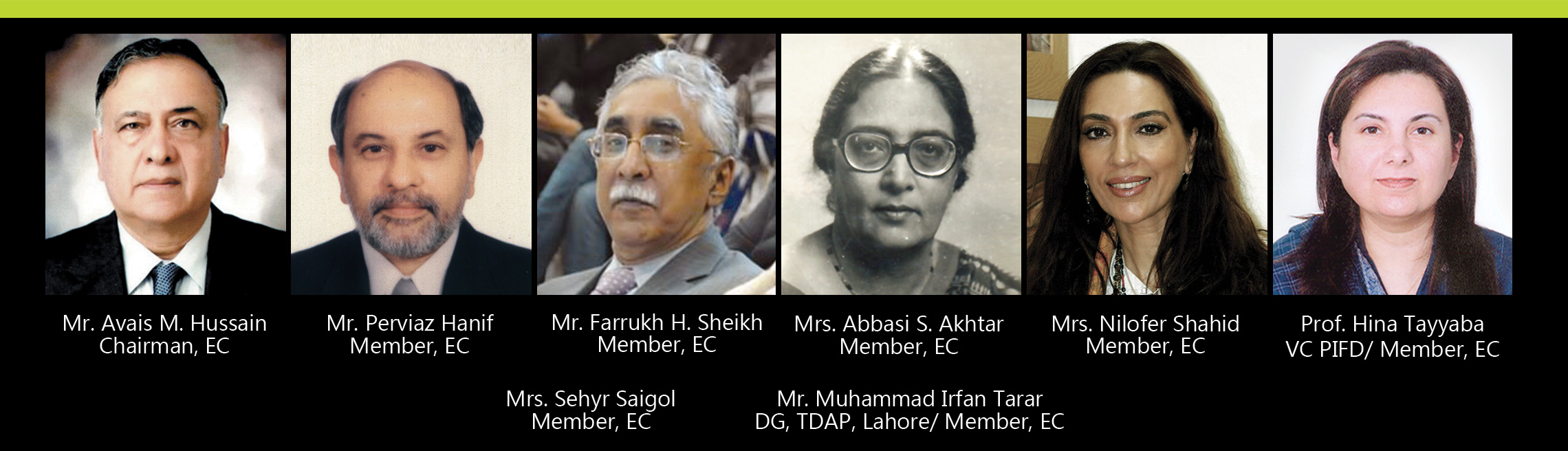
In 2007, the Ministry of Commerce, Chairman EC and Principal made concerted efforts and succeeded in getting NOC from Higher Education Commission for Degree Awarding Status. In this process, Minister for Commerce, Mr. Hamayun Akhtar Khan, Mr. Zahoor Hassan, Mr. Azmat Malik, Mr. Ata-ur-Rehman, Mr. Sohail Naqvi, Mr. Tariq Ikram, Mr. Syed Asif Ali Shah and Mr. Tasneem Noorani played a crucial and commendable role. The same year, collaboration with the Swedish School of Textiles, University College of Boras was established for student exchange and faculty training programme. Mr. Javed Akbar, then Commercial Counselor along with Mr. Kenneth, Director International Relations, Swedish School of Textiles were helpful in the process.
In 2008, the school was re-named as Pakistan Institute of Fashion and Design (PIFD) and assumed legal status on getting registered under the Companies Ordinance 1984. Mr. Shahzada Alam Monnoo, then Minister for Commerce, helped in a smooth transition of the Institute from Project to Company.
In 2009, Minister for Commerce, Makhdoom Amin Fahim, Secretary Commerce, Mr. Salman Ghani, Chief Executive TDAP, Mr. Syed Mohibullah Shah, and Secretary TDAP, Mr. Mirza Karim Baig fully supported the Institute. Simultaneously, the tedious and time-consuming process of legislation for the grant of Charter was effectively and ably negotiated by Mr. Zafar Mehmood then Secretary Cabinet. In the Standing Committee of the Parliament, Mr. Khurram Dastgir, Ms. Shereen Khan, Mr. Ishaq Dar and Mr. Haroon Akhtar Khan fully supported the Bill for grant of Charter. The passage of the Bill from the Parliament and its signing by the President of Pakistan on 29th April 2011 culminated an arduous journey from School to Chartered Institute.
PIFD developed National Curriculum for undergraduate degrees in Fashion and Design being member of National Curriculum Revision Committee (NČRC) of HEC. In the same year, the constructions of Purpose Built Campus was completed.
In 2016, PIFD became full member of Cumulus Association which is the only global association to serve Art and Design education and research which provides a forum for partnership and transfer of knowledge and best practices around the world. currently consists of 340 practices around the world, currently consists of 340 members from 61 countries. PIFD is the only Art and Design Institution in Pakistan which is a full member of the Cumulus Association.
In 2017, PIFD launched MPhil programme in Art and Design Education.
In 2018, Student Startup Business Center was established at PIFD and a women-focused, university-based entrepreneurship programme (KHUDI) to build support mechanisms that cater to the unique needs of women mechanisms that cater to the unique heeds ofwomeh entrepreneurs, launched with the help of PEP Foundation and the US State Department.
In 2019, PIFD became a partner Institution of Erasmus Mundus programme of European Union and is in their project "Erasmus+ Capacity Building in Higher Education and B-International".In the same year, the Administrative Control of PIFD was transferred from Ministry of Commerce to Ministry of Federal Education and Professional Training as per decision of the Cabinet Division, duly forwarded by the Ministry of Commerce on 31st December, 2019.
In 2020, PIFD became one of the members of Association of Common Wealth Universities which is the world's oldest international network of universities and its mission is to promote and support excellence in higher education the benefit of individuals and societies throughout the commonwealth and beyond. During these years PIFD established linkages with institutions around the world whicn assists to get aiverse exposure to keep which assists its students to get diverse exposure to keep them abreast with the latest trends around the world. Every year students from different departments make visits to France, UK, USA, Italy, Germany, Thailand etc. for workshops/ trainings.
PIFD signed a MOU with the Punjab Information Technology Board (PITB), Lahore, on 26th January 2021 for the establishment of a National Incubation Centre at PIFD premises. The project is designed to accelerate the successful development of business start-ups through an array of business support resources and services, developed and orchestrated by the incubator management and offered both in-house and through a network of contacts.
First virtual International exhibition titled; "Design Research Artifacts as an Intermediary Knowledge" was hosted by PIFD, in collaboration with Swedish School of Textiles, University of Borås, Sweden). It was curated by Dr. Vidmina, Researcher, Fashion Designer, and Artist based in Sweden; and Mr. Faseeh Saleem, Assistant Professor at PIFD and currently pursuing doctoral studies in University of Borås.
PIFD and National Information Technology hnology Boardard (NITB) inked a Memorandum of Understanding for E-Office implementation at PIFD; the Office Management System is installed and is in use.
PIFD adopted hybrid mode of teaching/ learning during the Covid-19 pandemic. The goal for hybrid learning included a combination of both online learning and face to face learning to create a singular learning experience that is flexible and offers synchronous communication between students andI teachers
In 2022, PIFD successfully managed to normalize post-covid situation by resuming regular academic and co-curricular activities. PIFD's international networking was significantly strengthened in 2022 through Erasmus+ program.
The Institute's collaborative approach was a result of the dynamic strategy developed in the past two years. PIFD's coherent approach for international collaboration involves student & staff mobility, research projects and development of Master's and PhD curriculum. A constant contribution to the existing body of knowledge is being made through attending and organizing national national anand international conferences, webinars, exhibitions, trainings and workshops.
The Faculty of Art, Design & Education and the Department of Art & Design Education were established.
The achievements of 318 students, graduated from seven undergraduate programmes and 10 students from MPhil in Art & Design Education were celebrated.
In 2023, PIFD hosted a two-day National Design Conference revolving around the basic theme of Art and Design practices. The event considered of five technical sessions, two panel discussions, and poster as well as paper paper present presentations. Leading industrialists, designers, researchers and academicians, along with a large number of students from different parts of the country participated in the conference.
In November 2023, the Pakistan Institute of Fashion and Design (PIFD) launched the B-International Toolkit. The event saw the presence of distinguished guests including representatives from partner European and Pakistani Universities. The occasion underscored the pivotal role of the B-International Toolkit in shaping the future trajectory of internationalisation in Pakistan's academic landscape.
In 2024, Prof. Hina Tayyaba Khalil, Vice Chancellor of PIFD, represented Pakistan at the Association of Commonwealth Universities (ACU) Council Meeting and Vice Chancellor Summit in London, UK. During the summit, she engaged with ACU Member Vice Chancellors, discussing critical issues facing universities today such as higher education funding, research management, and the impact of Al. The event offered a platform for high-level policy discussions and networking with vice chancellors policymakers, and international higher education stakeholders from across the Commonweal
These pages cannot adequately acknowledge the countless individuals and organizations that have supported the Institute. Building an institution is not the work of a single person or a short period; it is a process that spans decades and even centuries. The credibility and sustainability of such an institution are the result of the dedicated efforts of many selfless individuals and groups who tirelessly bring the vision to life. We extend our heartfelt gratitude to all those whose names are not mentioned here but who have significantly contributed to shaping the Institute and guiding its future.
1. The body responsible for the governance of the Institute shall be described as the Senate, and shall consist of the following, namely
2. The numbers of the members of the Senate described against clauses (f) to (i) of sub-section (I) may be increased by the Senate through statutes subject to condition that the total membership of the Senate does not exceed twenty-one, with the maximum of five Institute teachers, and the increase is balanced, to the extent possible, across the different categories specified in the sub-section(I).
3. All appointments to the Senate shall be made by the Chancellor. Appointments of the persons described in clauses (f) and (g) of sub-section (I) shall be made from amongst a panel of three names for each vacancy recommended by the Representation Committee set up in terms of section 23 and in accordance with procedure as may be prescribed Provided that effort shall be made, without compromising on quality or qualification, to give fair representation to women on the Senate Provided further that as regards the Institute teachers described in clause (h) of sub-section (I) the Senate shall prescribe a procedure for appointment on the basis elections that provide for voting by the various categories of the Institute teachers Provided also that Senate may alternatively prescribe that appointment of Institute teachers to the Senate shall also be in the manner provided by this sub-section for the persons described in clauses (f) and (g) of sub-section (I).
4. Members of the Senate, other than ex-officio members, shall hold office for three years. One-third of the members, other than ex-officio members, of the first Senate, to be determined by lot, shall retire from office the expiration of one year from the date of appointment by the Chancellor. One-half of the remaining members, other than ex-officio members, of the first Senate, to be determined by lot, shall retire from office on the expiration of two years from the date of appointment and the remaining one-half, other than ex-officio members, shall retire from office on the expiration of the third year. Provided that no person, other than an ex-officio members, may serve on the Senate for more than two consecutive terms Provided further that the Institute teachers appointed to Senate may not serve for two consecutive terms.
5. The Senate shall meet at least twice in a calendar year.
6 . Service on the Senate shall be on honarary basis Provided that actual expenses may be reimbursed as prescribed.
7 . The Vice-Chancellor shall be the Secretary of the Senate.
8 . In the absence of Chancellor, meetings of the Senate shall be presided over by the Deputy Chairperson. The Deputy Chairperson shall be the convener of the Senate. In case of absence of the Deputy Chairperson the Senate may elect a member, from amongst themselves, to chair the meeting.
9 . All decision of the Senate shall be taken on the basis of the opinion of majority of the members present. In the event of members being evenly divided on any matter the person presiding over the meeting shall have a casting vote.
10 . The quorum for a meeting of Senate shall be two-thirds of its membership, a fraction being counted as one.
1. There shall be Syndicate of the institute consisting of the following namely
2. The Registrar shall also be the Secretary of the Syndicate
3. Members of the Syndicate, other than ex-officio members, shall hold office for three years.
4. As regards the three professors described under clause (c) of sub-section (I) the Senate may, as an alternative to elections, prescribe a procedure for proposal of a panel of names by the Representation Committee set up in terms of section 23. Appointment of persons proposed by Representation Committee may be made by the Senate on the recommendation of the Vice-Chancellor.
5. The quorum for a meeting of the Syndicate shall be one-third of the total number of members, a fraction being counted as one.
6. The Syndicate shall meet at least once in each quarter of the year.
1. There shall be an Academic Council of the institute consisting of the followings, namely:
2. The Senate shall appoint the members of the Academic Council, other than the ex-officio and the elected members, on the recommendation of the Vice-Chancellor of the institute.
Provided that five Professors and the members representing the departments, institutes and the constituent colleges, the Senate may, as an alternative to elections, prescribe a procedure for proposal of a panel of names by the Representation Committee set up in terms of section 23. Appointment of persons proposed by the Representation Committee may be made by the Senate on the recommendation of the Vice-Chancellor.
3.Members of the Academic Council, other than the ex-officio members, shall bold office for three years.
4.The Academic Council shall meet at least once in each quarter of the year.
5.The quorum for meetings of the Academic Council, shall be one-third of the total number of the members, a fraction being counted as one.
| Name | Designation | |
| Mr. Qaiser Iqbal | Treasurer | Treasurer@pifd.edu.pk |
| Mr. Muhammad Umar | Assistant Professor | m.umar@pifd.edu.pk |
| Name | Designation | |
| Mr. Qaiser Iqbal | Treasurer | Treasurer@pifd.edu.pk |
| Mr. Muhammad Umar | Assistant Professor | m.umar@pifd.edu.pk |
| Ms. Fareeha Sardar | Assistant Professor | fareeha.sardar@pifd.edu.pk |
| Name | Designation | |
| Mr. Usman Khalil | Acting Course Coordinator (Ceramics &Glass Design) | usman.khalil@pifd.edu.pk |
| Name | Designation | |
| Ms. Fareeha Sardar | Assistant Professor/Coordinator LAFD | fareeha.sardar@pifd.edu.pk |
| Mr. Muhammad Aslam | Senior Psychologist | m.aslam@pifd.edu.pk |